We’re less than three weeks out from the UFC White House event and suddenly Dana White is everywhere. The UFC CEO is on the cover of Time Magazine, in the pages of Rolling Stone, and in podcast interviews with NPR and The New Yorker.
Not his usual media lineup, to put it mildly. We’re more used to seeing White sit down with Kick streamers and friendly podcasters, chopping it up with no apparent agenda or topic in mind. But with the UFC getting ready for a mainstream moment on the White House lawn, it seems that the boss man has been tasked with taking the message to the masses to set the stage ahead of the June 14 event at 1600 Pennsylvania Avenue.
But what is the message, exactly? That’s where it gets tricky. White’s current media blitz seems to be far more about the relationship between White and U.S. President Donald Trump — and the UFC as a vessel for that — than it is about any of the actual athletic activities scheduled for this event.
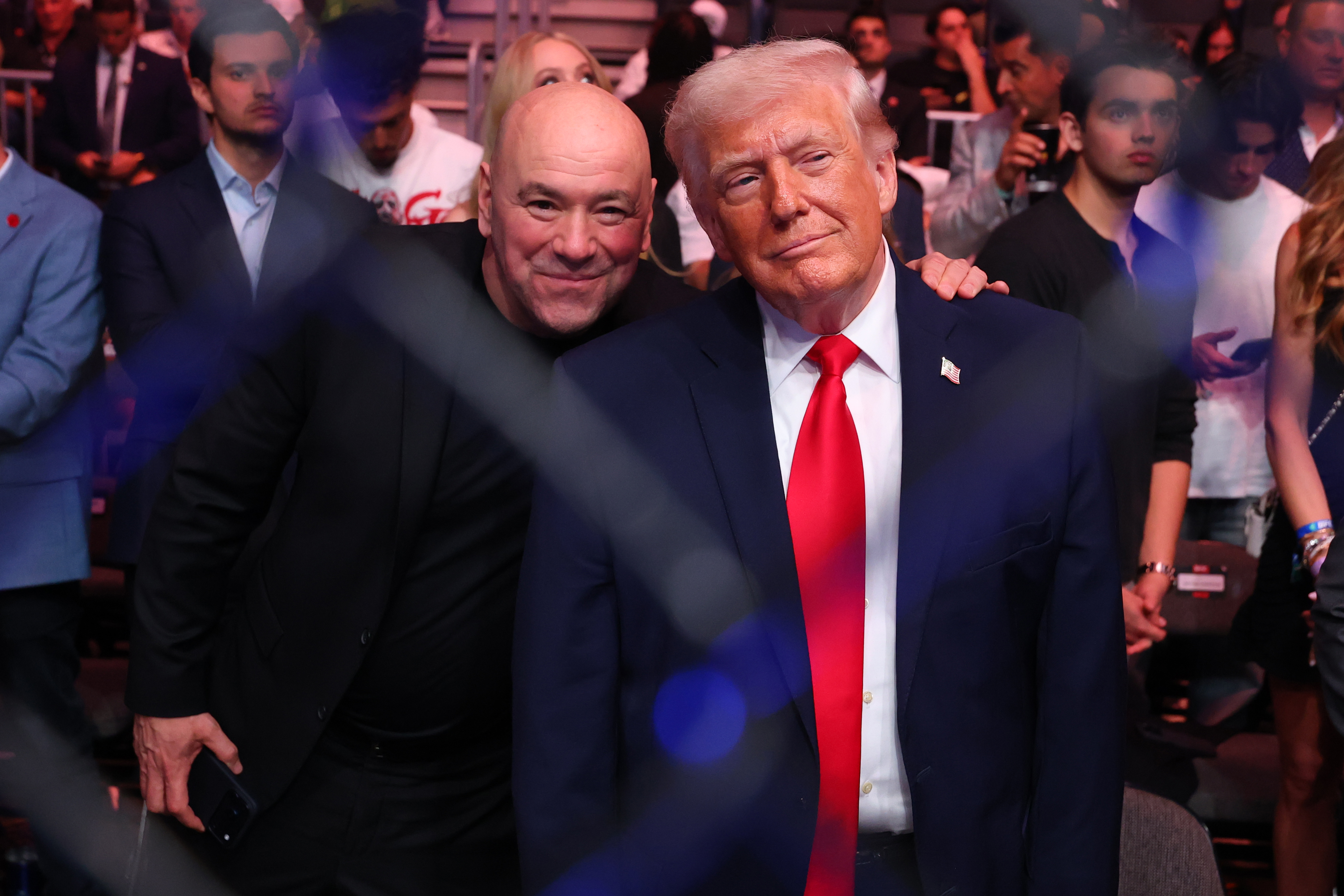
In his interview with NPR’s Steve Inskeep, for example, White spent less than one minute discussing Ilia Topuria and Justin Gaethje — the headliners of this White House event — and said almost nothing specifically about them beyond extolling their virtues as knockout artists. He spent more time, in fact, talking about his own past experiences in boxing, suggesting that he’d taken many of the same health risks his fighters do. (White has suggested over the years that he fought as an amateur boxer, but there is scant evidence of this.)
In his interview with David Remnick on The New Yorker’s “Political Scene” podcast, White at times got bogged down defending Donald Trump’s record and character, insisting that the president couldn’t be racist because White himself “would never associate with that type of person.”
“But if he does that,” Remnick fired back, referencing Trump’s social media post promoting a video that depicted the Obamas as apes, “how is he not that type of person?”
“He’s not,” White said, as if that settled the matter.
Bizarrely, White also brought up Trump’s friendship with Michael Jackson, seemingly to prove that Trump couldn’t be a racist if he’d been friends with a famous Black pop star. When Remnick pointed out that Jackson came with a lot of baggage, given the accusations that he sexually abused children, White professed ignorance.
“He was abusive?” White said.
“To kids, yes! It’s terrible,” Remnick replied.
“I don’t know if that’s true,” White said. “But I can tell you that the President had a very good relationship with Michael Jackson, and had Michael Jackson around his kids all the time, and, you know, defended him when that stuff was going down. So to call the guy a racist is crazy. He’s not a racist.”
Dana White: I can tell you the President had a very good relationship with Michael Jackson and had Michael Jackson around his kids all the time and defended him when that stuff was going down.pic.twitter.com/iJuR3VQPDO
— Jed I. Goodman © (@jedigoodman) May 22, 2026
In some of these interviews, White has seemed to want to paint himself as largely non-partisan, even suggesting that he’s politically left-leaning, which is a surprising claim from a man who’s been a repeat guest speaker at the Republican National Convention. But he also at times paints himself as an unofficial advisor to Trump, telling Time Magazine’s Sean Gregory that he convinced Trump to do Joe Rogan’s podcast while also “blowing up” Rogan’s phone in order to convince the podcaster and UFC commentator to endorse Trump.
“I was grinding on that thing right down to the last minute,” White said of the Trump-Rogan connection.
It’s all a difficult balancing act. White has insisted over and over again that he isn’t using the UFC to throw Trump a birthday party on the White House lawn. This is about celebrating America’s 250th birthday, he told NPR’s Inskeep, and it just “happened to fall on” Trump’s 80th birthday (June 14) rather than America’s (July 4).
But the UFC is a company that stages events almost exclusively on Saturdays. Breaking that pattern alone for a Sunday show is noteworthy. And it just happens to be on Trump’s birthday by pure coincidence? This strains belief.
Plus, if the event is celebrating America’s birthday, why does it take place three weeks before that very well-established date? It’s safe to say that if someone invited you to their Fourth of July cookout and then told you it was on June 14, you’d have some questions.
At least part of the goal of White’s current media offensive seems to be to counter any claim that this UFC fight card is a political event. Absolutely not, he’s said. It’s purely a patriotic celebration of America. And those seemingly monthly Trump walkouts at UFC events? That’s all about respect for the office of the President of the United States. He’d have been just as happy to have Joe Biden at UFC events, White has said.
At the same time, he told Inskeep very plainly: “We supported Donald Trump.” The “we” seems to be the UFC. When asked if that presented a problem for the company now that many of those in the UFC’s target demographic — young men — say they disapprove of Trump’s job performance, White’s response was to insist that it simply isn’t true.
“I don’t believe much in polls,” White said.
This latest batch of media rounds has put White squarely in the kind of crosshairs he used to try to avoid. There was a time when White wanted the UFC to be entirely apolitical, an escape from reality for fans from all points along the political and cultural spectrum. Now he’s gone all-in on supporting one of the most polarizing figures in American life, which must surely ingratiate him to some while completely alienating others.
The mainstream media focus for this event, at least for now, seems entirely fixated on the relationship between Trump and the UFC as a brand. White’s role in these appearances is to hype the event but also to hype Trump. Any suggestion that Trump has handled anything poorly or made even the slightest missteps gets immediate pushback from White in these interviews.
But there is almost zero attention paid to the individual fighters we’ll be tuning in to watch on June 14, which feels shocking from inside the MMA bubble, where the lineup for this event drove months’ worth of speculation. Now that we’re almost to fight night, it feels like the athletes are essentially an afterthought, just part of the scaffolding propping up this unprecedented intersection of sports and American politics.
Seeing as how the UFC is still, at the end of the day, a company in the business of selling us fights, that seems like a missed opportunity. But maybe that’s not how White and the UFC see it. Maybe this was always supposed to be the fighting event that is not at all about the fighters. Maybe, when this plan was first hatched, the possibility that it would lead to things like White on the cover of Time Magazine was a big part of the appeal.
One interesting thing about that cover, by the way? It identifies White as “The Promoter.” It makes no assertions as to what or who, exactly, he’s currently out here promoting.
About the Author
