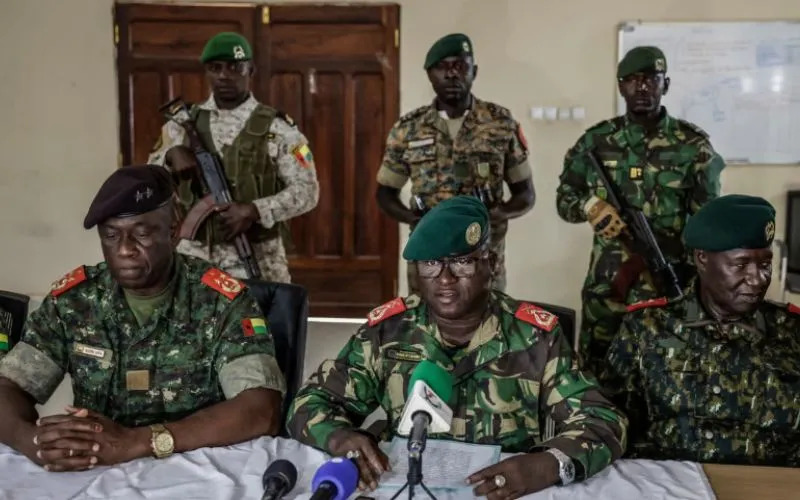
A group of soldiers has taken control of Guinea-Bissau, suspending the ongoing presidential election process just as the nation awaited the results from Sunday’s vote. In a televised announcement, the military leaders claimed they were acting to prevent a plot to destabilize the country, allegedly involving certain politicians and a “well-known drug baron.” As part of the coup, they also shut down the country’s borders and imposed a curfew.
Guinea-Bissau, located between Senegal and Guinea, has long struggled with political instability, with a history of frequent coups since it gained independence from Portugal in 1974. The military has played a dominant role in the country’s politics, which is also a major hub for international drug trafficking.
The election results, which were supposed to be released on Thursday, were eagerly awaited, especially after both incumbent President Embaló and his main rival, Fernando Dias, had each claimed victory. Dias, who had the support of former Prime Minister Domingos Pereira—who was barred from running himself—had been particularly vocal about his success. In a phone interview with France 24 on Wednesday afternoon, President Embaló confirmed his ousting, saying, “I have been deposed.” Reports later indicated that Dias, Pereira, and Interior Minister Botché Candé were also detained by the coup leaders. Additionally, army chief Gen Biague Na Ntan and his deputy Gen Mamadou Touré were reportedly arrested.
International election observers, including officials from the African Union and the West African bloc Ecowas, swiftly condemned the military takeover, expressing “deep concern” over the disruption. They emphasized that the election process had been “orderly and peaceful” and noted that both leading candidates had assured them they would accept the democratic result.
The coup began around 13:00 GMT when gunfire was heard in the capital, Bissau. While the exact details remained unclear, reports indicated widespread panic, with many residents fleeing the area. General Denis N’Canha, head of the presidential palace’s military household, later confirmed the coup, stating that the military had formed “the High Military Command for the Restoration of Order” and urged the public to remain calm.
By evening, the streets of Bissau were empty, with military checkpoints set up across the city ahead of a 19:00 GMT curfew. Portugal, Guinea-Bissau’s former colonial power, called for a return to constitutional order and urged all sides to avoid violence. This coup marks the latest chapter in a history of political turmoil for Guinea-Bissau, which has seen at least nine coups or attempted coups in the past 50 years.
President Embaló, 53, had previously claimed to have survived several coup attempts during his tenure. However, critics argue that he may have orchestrated some of these crises to suppress opposition. Despite earlier stating that he wouldn’t seek re-election, he had aimed to become the first president in 30 years to secure a second consecutive term. His legitimacy had already been questioned before the election delay, with opposition figures arguing that his term should have ended in February 2025.
This political upheaval unfolds in one of the world’s poorest nations, with a population of over two million. Guinea-Bissau’s extensive coastline and remote islands have made it a prime transit point for drug trafficking, and the United Nations has labeled it a “narco-state” due to its role in moving cocaine from Latin America to Europe.
About the Author
