By the time I first shared a space with Ronda Rousey, I had been covering Conor McGregor’s astronomical rise for more than half a decade.
Up until that moment, I hadn’t met someone with the same presence — kids would probably call it “aura” nowadays — as the Irishman. Yet, while I sat at the UFC 187 post-fight press conference at the MGM Grand Garden Arena, awaiting the post-fight insights of newly crowned light heavyweight champion Daniel Cormier, Rousey entered the room.
Every pair of eyeballs followed “Rowdy” as she strutted through. At the time she was the reigning UFC women’s bantamweight champion, an untouchable force, a cultural icon and arguably the only person who could rival the star power of McGregor, and she had the game in a chokehold as deadly as her signature armbar.
Fresh off her fifth win for the promotion, Dana White was proclaiming her the female equivalent to prime “Iron” Mike Tyson. Just two years into her UFC tenure, she had transcended the sport, landing roles in gargantuan Hollywood franchises “The Expendables”, “Fast & Furious” and “Entourage.” Four months after UFC 187, Beyoncé would feature Rousey’s “Do Nothing B****” speech during her main event performance at the Made In America festival. That same year, her autobiography, “My Fight/Your Fight,” was featured on the New York Times Best Seller List.
That balmy night in Sin City, you couldn’t have convinced me that we would only see Rousey win one more time in the Octagon — another blistering finish, this time of Bethe Correia — but assumption makes fools of us all.
It felt like Holly Holm head-kicked all that aura into oblivion in Melbourne, Australia, six months after I was spellbound by the starlet. The public wanted its pound of flesh and Rousey delivered the opposite, shielding her face with a pillow as she made her way through LAX on her arrival home. She would return a year later, refusing all media, before suffering another first-round knockout at the hands of Amanda Nunes.
One of the true superstars of the fledgling sport had burned out in front of our very eyes. For fans and media, Rousey’s inability to face the music left a bad taste, and even though she would go on to have successful runs in the adjacent world of professional wrestling, the relationship with MMA was left in a presumed state of disrepair.
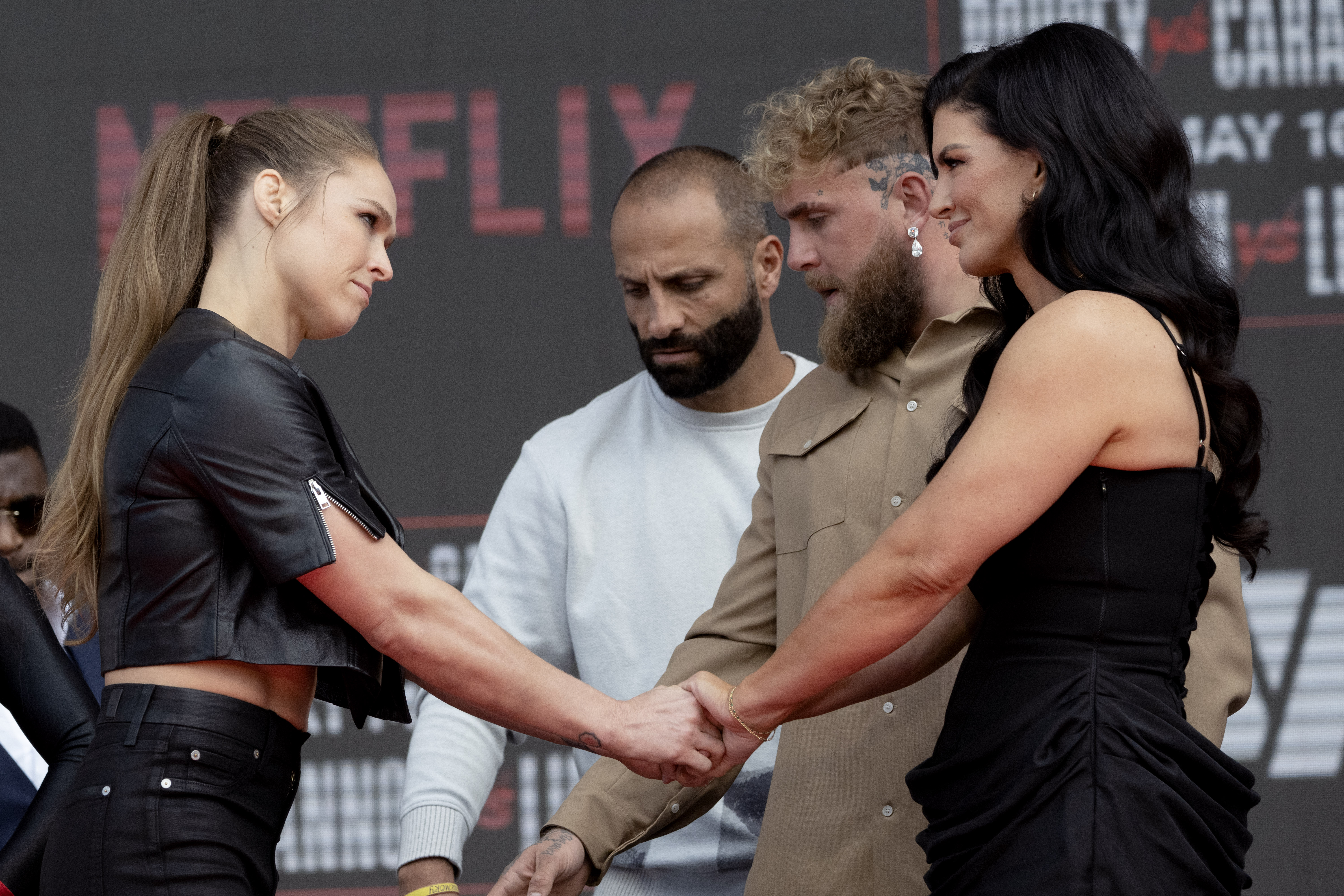
In the same way I couldn’t have been convinced that I’d seen Rousey’s penultimate UFC win that night at the MGM, I could have never predicted the Ronda redemption arc that has punctuated MVP’s maiden voyage into the world of MMA. As soon as she walked on the stage for the first press conference to tease her comeback fight against fellow trailblazer, Gina Carano, Rousey had us eating out of the palm of her hand once again. You could be fooled into thinking that she was selling us a fight with Carano, but her real foe is clearly modern-day UFC, the Hunter Campbell version, and the disrespect they showed her when negotiating a potential comeback.
And it isn’t just the “dismissive” negotiation process that’s in her crosshairs — Rousey has pitted herself as the opponent of industry power. Critics are more than welcome to be uninterested in the contest against another fabled pioneer, but true fans of MMA cannot deny the importance of a true challenger to UFC, an alternative place for negotiation and the undeniable power of streaming giant Netflix’s involvement with the sport.
As Rousey herself put it, UFC pissed off “the wrong b****,” and now backed by MVP and Netflix, she’s impassioned to make them pay.
“I love to be the designated b****,” declared Rousey on Monday’s episode of ”The Ariel Helwani Show.”
“I’m happy to play that role, and if anything happened any other way, the entire future of the sport would be different. I feel like this is meant for things to be better for all fighters. I had to go through those things to get to this point and be where I am now. Now, I get it.”
Things are trending in the right direction, but Rousey’s renaissance is far from complete. The proof is in the pudding, and until promoter MVP and Netflix can see the numbers their first event brings in, it’s unknown if there are more in the pipeline. However, MVP co-founder Nakisa Bidarian has hinted toward growing its MMA department.
Play 2026 Soccer Pick ‘Em with FOX One and make your picks for the world’s biggest soccer tournament
“Similar to when we did [Jake] Paul vs. [Mike] Tyson, people ask are you going to do more with Netflix. What I said then, and what I’m saying now is, if it goes well, I anticipate we’ll do more,” said Bidarian on Tuesday’s episode of ”The Ariel Helwani Show.”
While Rousey is adamant that her focus will be on family in the aftermath of Carano, there are some appetizing opponents for her beyond Saturday in the Intuit Dome. Unlike the case of heavyweight Francis Ngannou, there is far more than Philipe Lins equivalents on the menu should it be more than a one and done for MVP, Netflix and Rousey.
A rematch with Holm — now signed to MVP — would be perfect fodder for Netflix, but first we have to see if Rousey can still deliver.
The bookmakers’ odds would have you believe that Carano, fighting for the first time in nearly 17 years, is the perfect dance partner to provide an emphatic answer to that question. But, at least for Rousey, delivery is about far more than having her hand raised. Much like her first stint with the UFC, this second coming feels as much about protest as it is about performance. The first time around it was about forcing the door open for women; now it’s about achieving new standards for MMA athletes.
Can she compel the world to tune in again? Can she make them care about her new cause? Can she give us a spectacle as well as a sporting event? Does she still want to put herself through the rigors of fight camp at 39 years old? Is she still comfortable with every set of eyeballs being on her in every room she walks into, like that night at the MGM?
We’ll find out when “Bad Reputation” hits the speakers, the camera cuts to her signature mean mug and she makes that walk for the first time in 10 years.
About the Author
