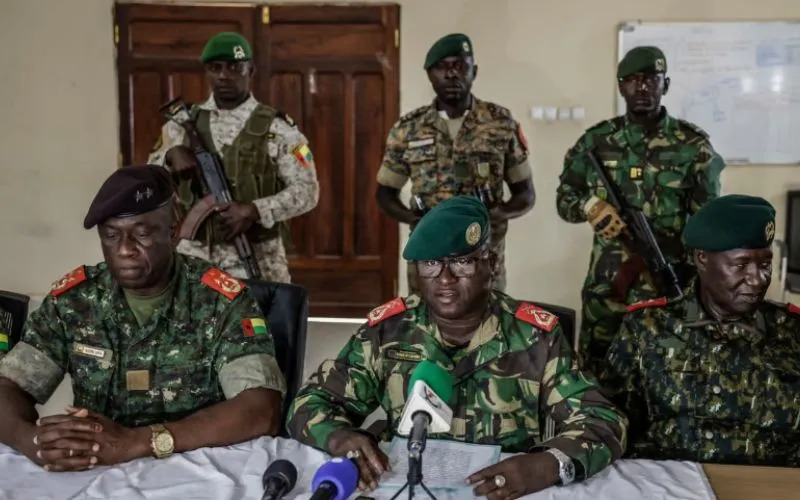
General Sworn in as Guinea-Bissau Leader After Military Coup
Guinea-Bissau’s military announced on Thursday that General Horta Nta Na Man had been sworn in as the country’s transitional president, following a swift coup that toppled the civilian leadership just days after a contested presidential election. The coup marks the ninth in West and Central Africa in the past five years and continues a pattern of instability in the nation, which has a long history of military interventions in politics.
The military, under the self-styled “High Military Command for the Restoration of Order,” declared on Wednesday that it had ousted President Umaro Sissoco Embalo. In a televised statement, they claimed the action was in response to a destabilization plot involving politicians and drug traffickers, although they provided no further details. The army stated that Nta would serve as president for one year.
Video footage on state media showed General Nta, dressed in military uniform, raising his right hand to be sworn in during a ceremony attended by other military leaders.
The coup came just a day before the electoral commission was set to announce provisional results of the fiercely contested presidential race between Embalo and Fernando Dias, a political newcomer who had emerged as his top challenger.
Gunfire and Uncertainty
Before the coup announcement, witnesses reported hearing gunfire in central Bissau near the electoral commission headquarters and the presidential palace. While there have been no confirmed reports of casualties, the situation has caused widespread anxiety in the capital.
President Embalo confirmed his ousting in a phone call to French media, saying he had been deposed. However, the military did not confirm whether they had taken Embalo into custody, and his whereabouts remained unknown on Thursday.
Condemnation from African Union and ECOWAS
The African Union and the West African bloc ECOWAS swiftly condemned the coup. In a statement, African Union Chairperson Mahmoud Ali Youssouf called for the “immediate and unconditional release” of President Embalo and all detained officials. ECOWAS also voiced concern over reports of the arrests of Embalo, senior government officials, and electoral personnel.
On the ground in Bissau, central areas were mostly quiet on Thursday, with soldiers patrolling the streets. Many residents remained indoors even after the overnight curfew was lifted, and businesses and banks were closed.
Political Tensions and Allegations
Ahead of the military takeover, Fernando Dias accused President Embalo of staging a “false coup attempt” to derail the election, fearing a loss. The political coalition backing Dias called for the immediate release of the election results and demanded the release of former Prime Minister Domingos Simoes Pereira, who was detained by security forces on Wednesday.
Tear gas was reportedly used to disperse a small protest outside the building where Pereira is said to have been held. Security forces also broke up another protest near Dias’s home, with witnesses reporting the use of live rounds, although there were no reports of casualties.
A History of Instability
Guinea-Bissau, a small nation located between Senegal and Guinea, has long been a hub for drug trafficking, particularly cocaine smuggled from South America to Europe. Under Embalo’s leadership, the cocaine trade had reportedly flourished, and analysts suggest that this may have influenced the political landscape.
Despite the recent coup, experts believe that Guinea-Bissau’s role in the global drug trade will remain largely unchanged. Lucia Bird Ruiz-Benitez de Lugo, director of the Observatory of Illicit Economies in West Africa, noted that traffickers had financed election campaigns in this cycle, indicating the continuing influence of narcotics on the country’s politics.
Election Observers Missing
Election observers from the African Union and ECOWAS expressed “deep concern” over the coup, particularly regarding the detention of electoral officials. Former Nigerian President Goodluck Jonathan, who had been part of the West African Elders Forum monitoring the election, was unreachable on Thursday, raising further concerns about the safety of international observers in the country.
Nigeria’s foreign ministry condemned the coup, describing it as an “act of military insurrection.” They also called for the safety of election observers to be ensured and warned that those responsible for the coup would be held accountable for their actions.
About the Author
