CHARLOTTE, N.C. — The whistle blew from the far side of the court with 9:09 remaining in Virginia’s ACC tournament quarterfinal, which meant the pressure was suddenly on Matt Hart.
The call had been goaltending against the Cavaliers, reducing their 11-point lead over NC State to nine. The Virginia bench was indignant.
“He blocked it first!” assistant coach Griff Aldrich yelled out, believing that a defender had actually tipped the shot as soon as it came off Ven-Allen Lubin’s hand, which by rule would nullify the goaltending.
Virginia head coach Ryan Odom, as he so often does when there’s a questionable call, glared toward Hart. Seated directly behind the head coach’s chair, his head buried in an iPad, Hart moved his finger over the screen like a digital ballet dancer — a swirl here, a tap there.
[Yahoo Fantasy Bracket Mayhem: Fill out brackets for your shot at $50K]
Within a matter of 10 seconds, he had seen the play a few times from multiple angles. Odom stood on the sideline, waiting for a verdict. Then, without even looking up, Hart put his index finger in the sky and twirled it around. It was all Odom needed to see.
“Any call that looks close, he’ll kind of turn to me,” Hart said. “He doesn’t have to say anything. I’m already looking to see, and he trusts whatever I say. If I say, ‘challenge,’ he’ll do it. If I say no, he won’t.”
Hart is officially the director of analytics for Virginia basketball, which is an important job for a program that is constantly looking for small advantages hidden in the numbers. But his more public-facing role is one that could generate a lot more conversation this March.
For the first time in the NCAA tournament, coaches will have the option to use a timeout and appeal a limited range of referee’s calls, including out-of-bounds plays, goaltending/basket interference and whether a defender’s feet were in the restricted area on block-charge calls. If the coach is right, they can use a second challenge. If they’re wrong, it’s gone.
Though the range of calls you can challenge in college is more limited than the NBA, it’s not far-fetched that at some point this weekend, a request for instant replay could determine who advances in the tournament — or, if wrong, cost someone a game.
Which means someone like Hart or the 67 others who have the same responsibility could, for the first time, be an NCAA tournament hero.
Or a goat.
“I love it,” Hart said.
And why not? Virginia, Hart said, only lost one challenge all year in an early season game when they were up by 25 or 30 points — “No stakes at all,” he said. If anything, Virginia would prefer a more expansive ability to use replay, in part because Hart is so good at his job. Again, for a staff always looking for an edge on the margins, a well-timed challenge — like the one they called for in the NC State game, which took two points off the board in an eventual 81-74 win — is an area Virginia feels like it can exploit.
“I think we all like it,” Odom told Yahoo Sports. “I would rather it be exactly like the NBA and be able to challenge other stuff. I think it’ll happen in due time. You kind of have to baby step some of this stuff, but I think it works out and there are some big plays that happen within games — we’ve certainly had many this year — where maybe another team loses their challenge and they can’t challenge at a key time. We’ve been pretty fortunate and conservative with ours. I just trust Hart. I trust his discretion.”
The NCAA added the coach’s challenge this season in hopes of reducing the number of times officials went to the monitor. In the past, they’d look at almost every out of bounds call in the last two minutes, which certainly had noble intent because everyone wants to get the calls right. But doing a forensic examination on which fingertip was the last to touch a ball on every close play tended to bog down the end of games.
Now, under the new rules, officials can only initiate a review in the last two minutes on a goaltending or a charge circle call. If there’s an out-of-bounds question, the coach has to use a challenge — which means there’s a real strategy in how and when it’s deployed.
Hart, who averaged 4.0 points in two seasons at George Washington, played a bit professionally overseas before being introduced to Odom through a mutual friend and landing on the Utah State staff as a graduate assistant in 2022.
When Odom went to VCU the following year, Hart came along as the director of analytics, where part of his job on the bench was to monitor the game via iPad and tag plays to show the team at halftime.
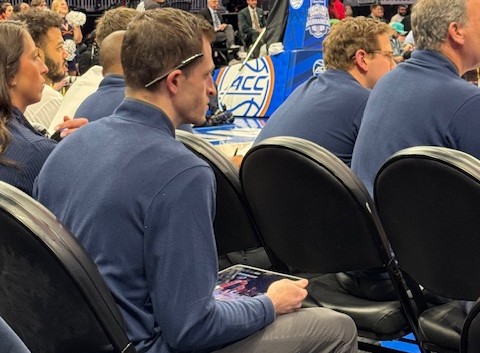
That made it a pretty smooth transition when the challenge system was introduced through DVSport, whose software platform allows him to track the game with minimal delay — usually just two seconds or so.
Early in the season, when the system was still new, people in Hart’s role struggled to get the challenge calls in quick enough because referees were just moving on to the next play immediately. But as the season has gone on, ACC senior vice president for men’s basketball Paul Brazeau said that officials have been told to take an extra few seconds on close plays so that the bench can make a decision.
Before the season, Hart said, he spoke to counterparts in the NBA to gain some insight on how to use the challenges and looked at analytics suggesting that the value of using the challenge was much greater the closer you get to the end of the game.
“Each possession is worth more when you get down to one minute, two minutes,” Hart said. “So we’d only use it in the first half if you’re 100 percent positive. If it’s questionable, it’s not worth it. I haven’t used it a lot where I was unsure. It’s really only been when I’m positive we’re going to get it. So that’s how I view it unless we’re down and it’s just a Hail Mary.”
Another piece of data Virginia has collected is that roughly 90 percent of the calls they’ll challenge are out of bounds and that 75 percent of the challengeable calls happen on the baselines. So when Hart is watching the game on the iPad, he’ll do it almost exclusively via the baseline camera angle to speed up the process. All in all, Hart has access to six different cameras that he can check with a swipe of the finger.
And at the end of the day, it’s entirely his call whether to challenge or not.
“He just tells me yes or no pretty quick,” Odom said. “He does the best he can. If he’s unsure, he’ll [shake his head no]. But there have been times where officials have told me, ‘I think I got that one right’ but [Hart] was right, actually.”
Every coach approaches it a bit differently. Duke’s Jon Scheyer, for instance, will ask Trevor Marcus, his video coordinator, what they’re seeing on the iPad but will request at times to see the play himself before signaling for a challenge.
That’s understandable, too, because ultimately the head coach is responsible for how to use their timeouts regardless of whether the challenge is successful. And now that it’s a factor in the NCAA tournament, the consequences are sky high. A misspent challenge — or failing to challenge a bad call — could end someone’s season.
The stakes for Virginia were not quite that high in the ACC tournament, as they advanced to the final before losing to Duke, 74-70. But still, the NC State game was another validating moment for the Cavaliers’ challenge process. After a few minutes of studying the monitor, officials saw what they missed in real time: Big man Thijs De Ridder had blocked the shot before the goaltend, making it a clean play.
Hart was right again.
“I had [the iPad] on the perfect angle,” he said. “Goaltends, even though they don’t happen a lot, those are so valuable because that’s actual points you can get back. We got back two points today because of that.”
He hopes it works out as well on Friday when Virginia, a No. 3 seed in the Midwest Region, plays Wright State. For Hart, the spotlight is going to be bright.
“I’ve never been in a situation where I felt horrible that we lost one,” Hart said. “But the players all know that’s my job so when we get one right, it’s cool, they shout my name, and Ryan has been really awesome about trusting me.”
About the Author
